
Textile Design Hubs
Print/Download Page As PDF
Invest in Lesotho’s
Textile
Design Hubs
LESOTHO: Pioneering Sustainable and Ethical Fashion from the Heart of Africa.

Introduction
The Government of Lesotho, in partnership with the private sector, invites a strategic international investor to establish a pioneering Textile Design & Innovation Hub in Maseru.
This landmark initiative is launched at a pivotal time, leveraging Lesotho’s duty-free, quota-free access to the EU under the SADC EPA and positioning the nation as a sustainable sourcing partner for global brands. It is aimed at coordinating industry-wide innovation, moving beyond cut-make-trim (CMT) operations to create high-value, uniquely Basotho products and services. We are seeking an international investor and technical partner to co-develop this integrated facility, which will serve as a catalyst for the entire sector, leveraging preferential market access and a commitment to ethical production. The Hub will centralize high-value services—from rapid prototyping and material testing to specialized skills training – catering to regional and international demand.

Strengths &
Opportunities
Lesotho is poised to redefine its role in the global textile industry by establishing a central hub for design, innovation, and sustainable technology.
Lesotho’s base of graduates, skilled textiles workforce and university innovation hubs will feed into the design hub. Mentorship, trade access, technical support and finance will be the key elements of the design hub’s offering. Partners will include major manufacturers, brands and institutes in the global garments and textiles industry.
Market Evidence
Assured EU Market Access:
Under the EU–SADC Economic Partnership Agreement (EPA), Lesotho’s goods enjoy preferential, duty-free, and quota-free access to the European Union. The recent launch of the EPA Market-Access Portal (March 2025) simplifies rules of origin and procedures, providing a clear and streamlined pathway for exporting textile inputs, accessories, and finished goods to this high-value market.
Regional Demand Pull:
South Africa’s Clothing, Textile, Footwear, and Leather (CTFL) value chain is actively pursuing policy-backed localization and sustainability. This creates immediate, nearby opportunities for the Hub to offer design, prototyping, trims, and testing services to South African buyers seeking to de-risk and enhance their own supply chains.

Global Sustainable Materials Shift:
Global fibre production reached a record 132 million tonnes in 2024, with intense pressure from brands for sustainability and traceability. This opens a strategic window for Lesotho’s low-impact natural fibres (wool, mohair), recycled inputs, and clean-process innovations, which the Hub is designed to champion and scale.
Logistics Momentum:
The recent R60 million upgrade to the Port of East London’s automotive berth (2025) has increased throughput efficiency. This enhances logistics for consolidating and shipping high-value consignments, including fashion and automotive textiles, via the Eastern Cape corridor.
U.S. Market Strategy:
While AGOA expired in October 2025, the U.S. remains a key market. The strategy is to compete on value and quality under MFN tariffs, with a flexible structure to swiftly leverage benefits if AGOA is re-authorised in the future.
Where Heritage Meets Innovation In Textiles
Lesotho offers a distinctive proposition in the global fashion and materials sector, blending unique cultural design with a firm commitment to sustainability. We are a source for premium, naturally derived materials – including wool, mohair, leather, and innovative plant-based fibres.
Our capabilities extend to high-value export niches such as technical workwear, textile accessories, and automotive interiors. A core differentiator is our dedication to clean manufacturing: utilizing renewable energy, eliminating hazardous substances, and pioneering circular processes like anaerobic digestion. This makes Lesotho the ideal partner for brands seeking quality, innovation, and verified sustainable credentials.
Incentives
Low Corporate income tax:
• 10% on profits
Training:
Cost of Lesotho citizens allowable at 125% for tax purposes
Withholding tax:
• 10% on service contracts with non-residents
• 25% on dividends distributed from income by resident companies to non-resident shareholders
• No withholding tax on dividends distributed to Lesotho residents
VAT:
• 15% on goods and services sold in Lesotho
• 0% on direct exports
Risk guarantees:
• Partial credit guarantee through the LNDC
• Facilitation support to identify and mobilize labour and skills development partnerships
Support from the LNDC includes:
• Serviced industrial and commercial sites at competitive rentals
• Provision of industrial and commercial buildings at competitive rentals
• Financial assistance on a selective basis
• Investment facilitation services
• Assistance with permits and licenses
• Assistance with company registration
• Assistance with industrial relations issues
• Appraisal of investment projects
• Assistance with preparation of project briefs for the Environment Impact Assessment (EIA) Certification
Strengths & Opportunities
Lesotho is building a globally connected, ethically certified textile and apparel ecosystem, ready to host design hubs and support international standards bodies seeking a reliable, compliant base in Africa.
The country also seeks to strengthen its intellectual property (IP) commitments in order to exploit indigenous designs and move up the value chain.
Strategic Advantages
The Lesotho Advantage:
Policy & Tax Clarity:
Lesotho offers a transparent and attractive fiscal environment. Investors benefit from a standard Corporate Income Tax (CIT) of 25%, with a special rate of 10% manufacturing, applicable to production modules within the Hub.
Market Access & Proximity:
Lesotho provides a unique trifecta of market access:
The scale of the Southern African Customs Union (SACU), preferential duty-free entry to the EU/UK, and daily Airlink flights to Johannesburg. This facilitates effortless buyer visits, quality assurance checks, and just-in-time design collaboration.
Digital & Testing Readiness:
Lesotho has extensive national 3G & 4G (LTE) coverage while Maseru has robust and growing 5G connectivity. This ensures reliable, high-speed internet essential for digital design, CAD/CAM collaboration, and e-commerce operations.
Inherent Sustainability Positioning:
Lesotho’s national ambition for clean-process manufacturing – focusing on water and energy efficiency and chemical stewardship – is a core brand identity. This aligns perfectly with global brand compliance requirements and will be an anchor theme for the Hub’s labs and pilot production lines.
The Maseru Travel to Work Area:
THE MASERU TRAVEL TO WORK AREA HOLDS 200 000 OF THE NATIONAL POPULATION OF 2.3M. With a responsive talent pool and 490,000 people in the Maseru work zone, Lesotho is primed for investment in design and tech innovation hubs, anchored by Maseru as a launchpad for nationwide skills and startup acceleration.
List of investment opportunities
The investor/partner will co-develop and operate the Hub, which will offer a centralized ecosystem of five core, revenue-generating services:
Design-to-Prototype Studio:
An open-access studio offering industry-standard services including digital pattern making (CAD/CAM), 3D sampling, knit & weave trials, and small-batch prototyping. It will host designer residencies to serve both burgeoning Lesotho brands and specialist international buyers, drastically reducing sample lead times.
Sustainable Materials & Trims Lab:
A dedicated lab for testing and certifying materials for colour fastness, REACH/RSL compliance, recycled content, and bio-based innovations. The lab will include a showroom curating a range of sustainable trims (buttons, zips, labels) for regional buyers, simplifying their sourcing.
Accessory & Components Micro-Manufacturing:
Small-scale, agile production pods dedicated to manufacturing labels, trims, packaging, and select automotive textiles (e.g., seat-cover fabrics, headliners). This initiative is designed to plug into the established Eastern Cape automotive OEM supplier networks, capturing a niche but high-value segment.
Skills & Incubation Academy:
A dynamic academy offering short bootcamps in critical skills such as tech pack creation, digital design, sustainability metrics (LCA, Higg Index), and entrepreneurship. It will formally partner with universities, TVET colleges, and global brands to provide mentorship, ensuring a continuous pipeline of industry-ready talent.
Buyer Services & Sourcing Desk:
A centralized desk to facilitate international trade by consolidating services for EU EPA compliance, rules-of-origin verification, and vendor matchmaking. By leveraging the new SADC-EU EPA portal and the EU’s Access2Markets platform, this service will reduce the cycle time from design brief to purchase order for international buyers.

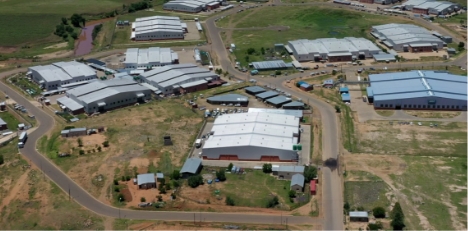
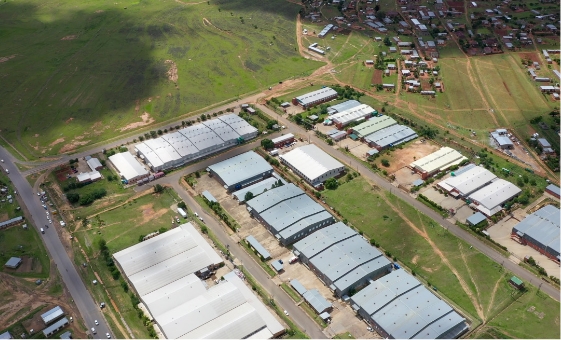
Belo Industrial Park, Butha Buthe.
Financial Analysis
A total investment of approximately:
USD 5m
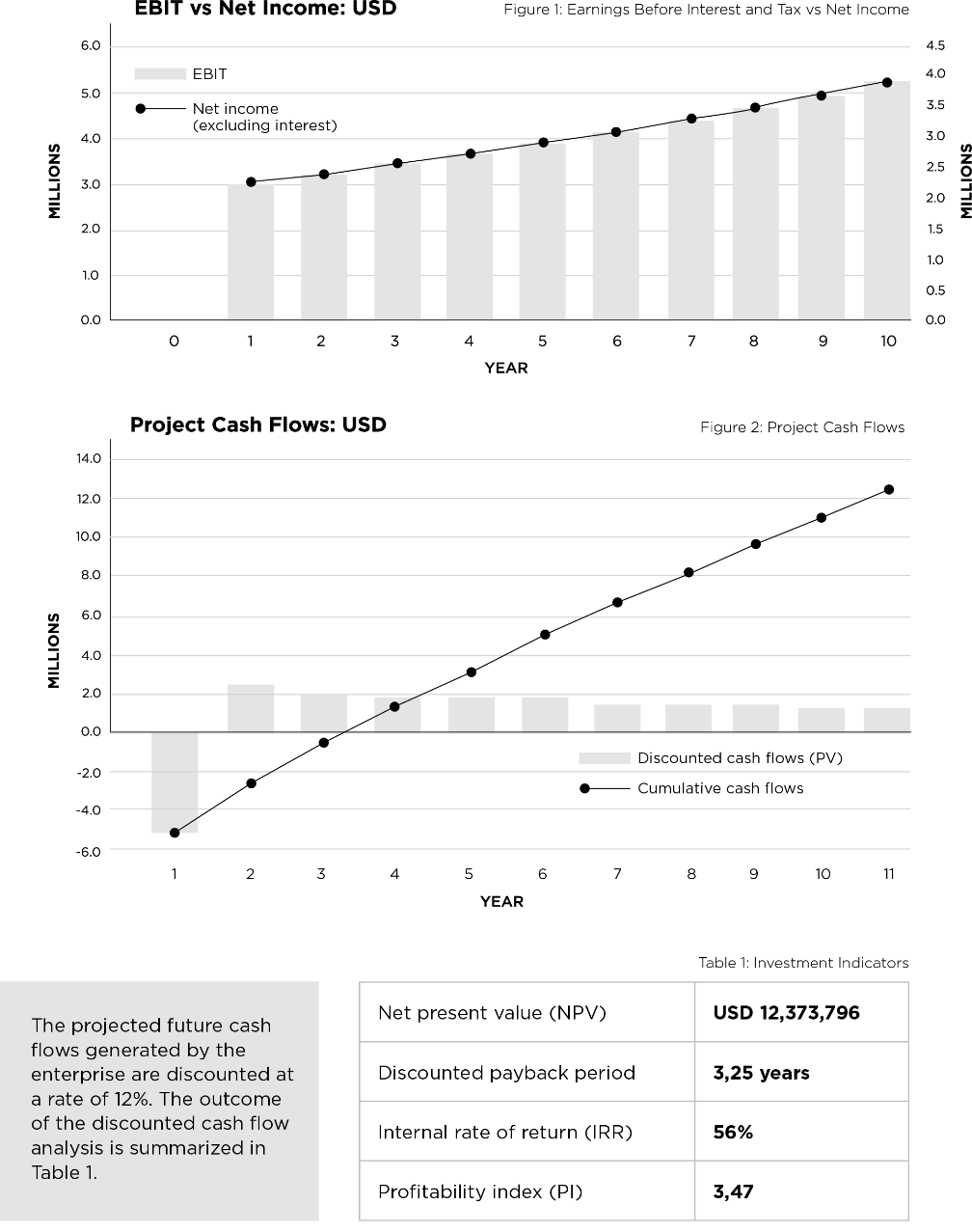
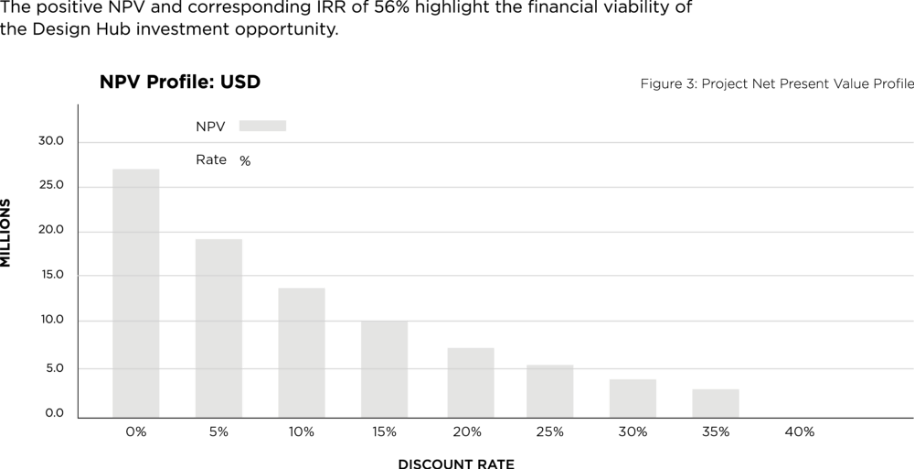
comprising fixed assets of USD 3.4m, pre-production expenditure of USD 300k and initial working capital of USD 1.3m will be required for the establishment of the Textile Design Hub. The graphs below illustrate a financially viable operation with the opportunity expected to generate a profit throughout its operational life.
In addition to the positive NPV and IRR, the initial investment cost of the project is expected to be fully recovered in just over 3 years. The investment opportunity also responds favourably to the Country’s developmental objectives through its positive socio-economic impact in terms of employment creation, economic agglomeration and potential forex earning opportunities.
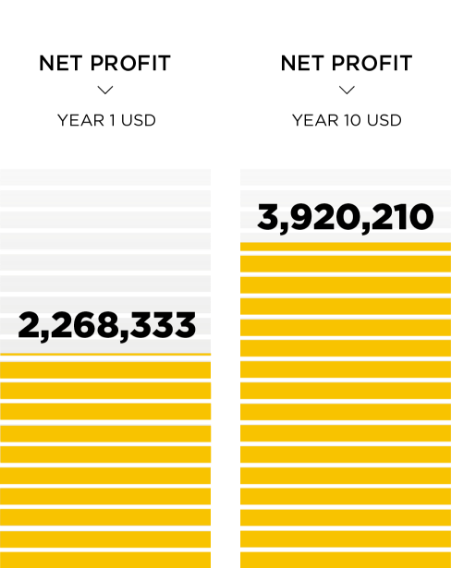
The enterprise’s annual net profit after tax increases from
USD 2.2m
in year 1 to approximately:
USD 3.9m
in year 10.
Similarly, the projected cash flows of the envisaged project indicate that it will generate positive net cash flows throughout the 10-year operational period.
Financial Analysis
NOTE
This is a mid-sized textile design hub focusing on creative services such as pattern development, prototyping and CAD-based innovation for Lesotho’s garment sector. The hub has envisaged production capacity of 500 design projects annually. The financial analysis of the textile Design Hub investment opportunity is computed over a ten-year period. Revenue and expenditure projections are in line with industry growth prospects and market potential and have been informed by and benchmarked against industry standards and norms. In addition, assumptions relating to inflation: depreciation and salvage value: and company tax have been worked out based on the existing laws and directives of the country. The figures above represent high level estimates as of January 2021 and are not derived from a full feasibility study. Investors are advised to conduct their own due diligence.



DISCLAIMER
This web page provides a strategic overview. All financial figures are based on a high-level investment opportunity model and should be used as an indicator of potential only. Investors are strongly encouraged to conduct independent due diligence and a full feasibility study with the support of the LNDC to validate all assumptions under current market conditions.